Section 8 Company Registration in India is ideal for organizations established with a charitable or not-for-profit purpose — such as promoting education, social welfare, art, science, sports, environment protection, or similar objectives.
Benefits of Section 8 Company Registration
Tax Benefits – Eligible for income tax exemption under Section 12A & donors get tax deduction under Section 80G.
Credibility & Recognition – Highest level of trust compared to Trusts and Societies; preferred by CSR donors, government bodies, and international agencies.
Separate Legal Entity – Section 8 Company has its own legal status, can own property, sue, or be sued independently.
Limited Liability – Members’ liability is limited to their capital contribution; personal assets remain safe.
No Minimum Capital Requirement – Can be incorporated with any capital.
Exemption from “Company” Suffix – Allowed to use words like Foundation, Association, Forum, Council, Federation, Chamber, Confederation, Electoral Trust, etc.
Access to Grants & CSR Funds – Easier eligibility to receive domestic and foreign contributions (FCRA)
Benefits of Section 8 Company Registration
Tax Benefits – Eligible for income tax exemption under Section 12A & donors get tax deduction under Section 80G.
Credibility & Recognition – Highest level of trust compared to Trusts and Societies; preferred by CSR donors, government bodies, and international agencies.
Separate Legal Entity – Section 8 Company has its own legal status, can own property, sue, or be sued independently.
Limited Liability – Members’ liability is limited to their capital contribution; personal assets remain safe.
No Minimum Capital Requirement – Can be incorporated with any capital.
Exemption from “Company” Suffix – Allowed to use words like Foundation, Association, Forum, Council, Federation, Chamber, Confederation, Electoral Trust, etc.
Access to Grants & CSR Funds – Easier eligibility to receive domestic and foreign contributions (FCRA)
Directors – Minimum 2 directors (at least one must be an Indian resident).
Members – Minimum 2 shareholders/members (directors can also be members).
Capital Requirement – No minimum paid-up capital required.
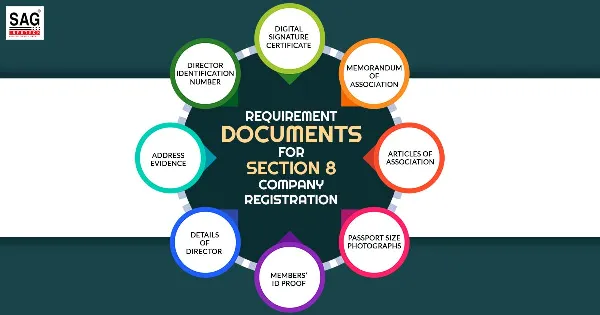
Registered Office Address – Valid address proof (ownership or rental + NOC).
Director Identification Number (DIN) – Mandatory for all directors.
Digital Signature Certificate (DSC) – Required for e-filing with MCA.
Charitable Objects – Must have clear objectives related to social welfare, education, environment, art, science, or other non-profit purposes.
Name Approval – Must end with words like Foundation, Association, Federation, etc. (not “Private Limited” or “Limited”).
|
Category |
Document Required |
Purpose / Use |
|
Directors / Members |
PAN Card (Indian nationals) |
Mandatory identity proof |
|
|
Aadhaar / Voter ID / Driving License |
Secondary ID verification |
|
|
Passport (foreign nationals) |
Proof of nationality |
|
|
Recent Address Proof (Bank Statement / Utility Bill – not older than 2 months) |
Residential address verification |
|
|
Passport-size Photograph |
For MCA incorporation records |
|
Registered Office |
Utility Bill (Electricity/Telephone/Water – not older than 2 months) |
Proof of office location |
|
|
Rent Agreement (if rented) |
Legal right to use premises |
|
|
No Objection Certificate (NOC) from owner |
Owner’s consent for using property |
|
Company Setup |
Digital Signature Certificate (DSC) |
For signing MCA forms |
|
|
Director Identification Number (DIN) |
Unique ID for directors |
|
|
Proposed Company Name |
For MCA approval |
|
|
Draft MOA & AOA with Charitable Objects |
Defines the vision & governance of NGO |
|
Deliverable |
Description / Use |
|
Certificate of Incorporation (COI) |
Proof of NGO registration issued by MCA with CIN. |
|
PAN (Permanent Account Number) |
For taxation & compliance. |
|
TAN (Tax Deduction & Collection Account Number) |
Mandatory for TDS deductions. |
|
DIN (Director Identification Number) |
Unique ID issued to directors. |
|
Digital Signature Certificates (DSC) |
Used for filing forms with MCA. |
|
Memorandum of Association (MoA) |
Defines charitable objectives of NGO. |
|
Articles of Association (AoA) |
Governs internal management. |
|
Company Master Data (MCA Portal) |
Public record of NGO details. |
|
Bank Account Opening Kit |
To open a current account in NGO’s name. |
|
12A & 80G Certificates (Post-Incorporation) |
Tax exemptions for NGO & donors (to be applied separately). |
|
FCRA Registration (if applicable) |
To receive foreign donations. |
Minimum 2 Directors and 2 Members for a Private Limited Section 8 Company
Minimum 3 Directors and 7 Members for a Public Limited Section 8 Company
At least one director must be an Indian resident
Company name must reflect charitable nature
Name should not include “Private Limited” or “Limited”
Name approval through RUN (Reserve Unique Name) service on MCA portal
Registered office must be in India with valid address proof
Required documents for directors and shareholders: PAN, Aadhaar/Voter ID/Passport/Driving License, passport-size photographs, email ID, mobile number
Required documents for registered office: utility bill, rent agreement or ownership proof, NOC from property owner
All directors must have Digital Signature Certificate (DSC)
Director Identification Number (DIN) must be obtained before filing forms
MOA and AOA must define charitable objectives
Profits must be used only for promoting objectives, not distributed among members
Apply for Section 8 License with ROC along with supporting documents
Central Government grants license after verification
Maintain proper books of accounts
File annual returns and financial statements with ROC
dhere to all regulations under the Companies Act, 2013.
Tax exemptions under Sections 12A and 80G of the Income Tax Act
Limited liability protection for members and directors
Separate legal entity with independent identity
High credibility and government recognition
No minimum capital requirement
Exemption from using “Private Limited” or “Limited” in the name
Eligibility for government grants and foreign funding (FCRA)
Perpetual existence ensuring long-term stability
Ideal structure for NGOs, trusts, and charitable organizations
Tax exemptions under Sections 12A and 80G of the Income Tax Act
Limited liability protection for members and directors
Separate legal entity with independent identity
High credibility and government recognition
No minimum capital requirement
Exemption from using “Private Limited” or “Limited” in the name
Eligibility for government grants and foreign funding (FCRA)
Perpetual existence ensuring long-term stability
Ideal structure for NGOs, trusts, and charitable organizations
Contact us today to discuss your requirements and get a personalized quote
Start Today Call Now